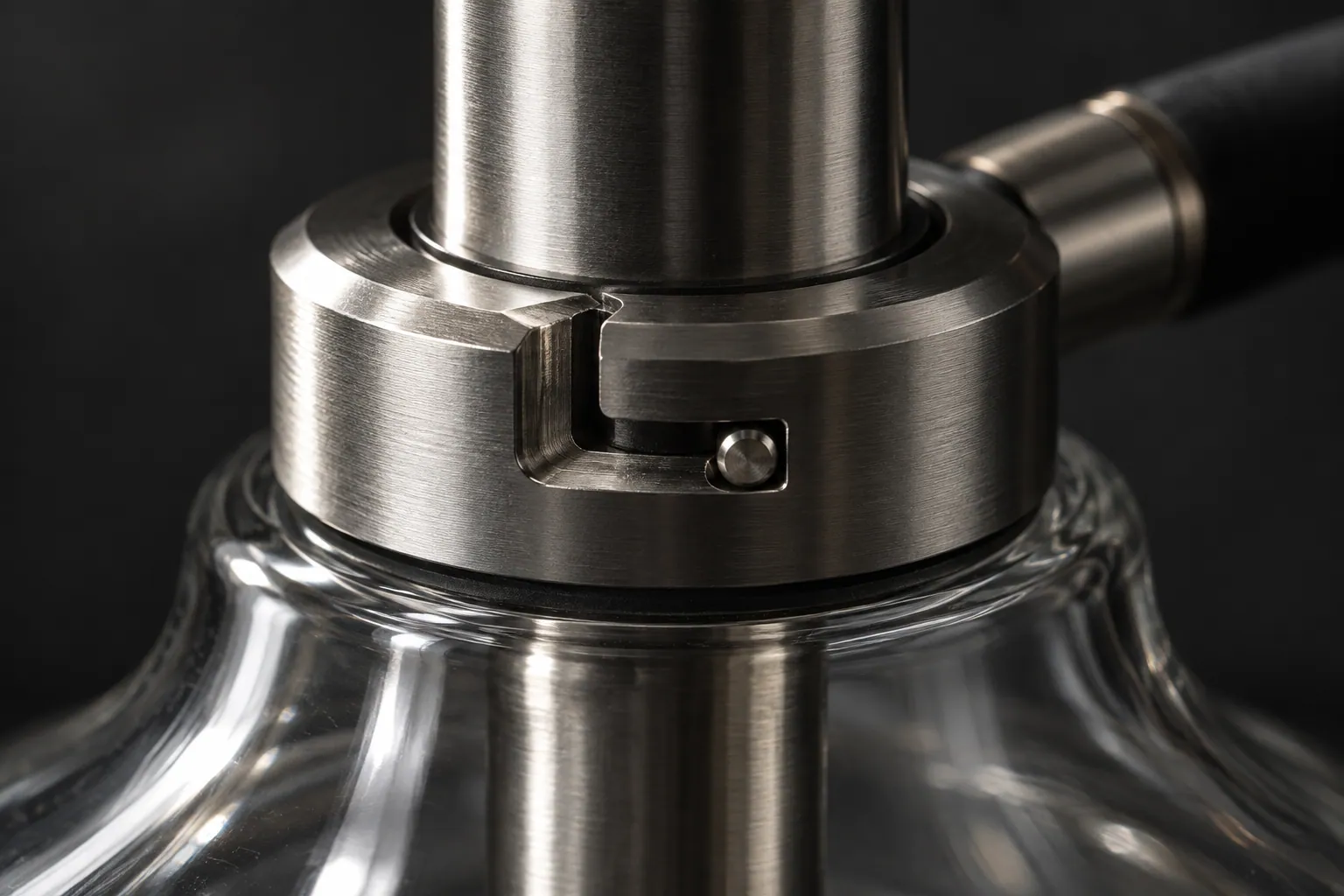
Bayonet connection
No threads between body and bottle or body and bowl. A three-channel bayonet locking in a quarter turn. Fitted and removed one-handed, with no risk of stripping a thread.
3 × 90° · FKM O-ringNARION is currently at T0 — technical drawings and CNC prototype. The product is not in series production yet; the dimensions, materials and performance figures on this site are design decisions, not verified field results.
“Durable” is not a marketing line but a claim that has to be verified. The protocol below will be an annex to the contract-manufacturing agreement: a batch that fails the acceptance criterion is rejected.
This is where the commercial logic of the family sits. These six details are identical across the range; differentiation is limited to size and finish.
No threads between body and bottle or body and bowl. A three-channel bayonet locking in a quarter turn. Fitted and removed one-handed, with no risk of stripping a thread.
3 × 90° · FKM O-ringBody and immersion stem are machined as a single part. With no weld and no threaded joint, the classic leak point is entirely absent.
Ø16 mm (C/H) · Ø14 mm (T)Eight radial holes at the end of the stem. Smaller bubbles, lower draw noise and lower draw resistance.
8 × Ø2,5 mmA silicone diaphragm instead of a ball valve, designed to run silently, resist clogging and come out for washing. In café use the ball valve is classically the first part to fail.
LSR ⌀ 32 mmDraw resistance is measured per model and printed on the technical sheet. Almost no competitor publishes this figure — in the upper segment it is the cheapest way to build technical trust.
Seven parts without tools; all parts are intended to be dishwasher safe.
7 pcs · 70 °C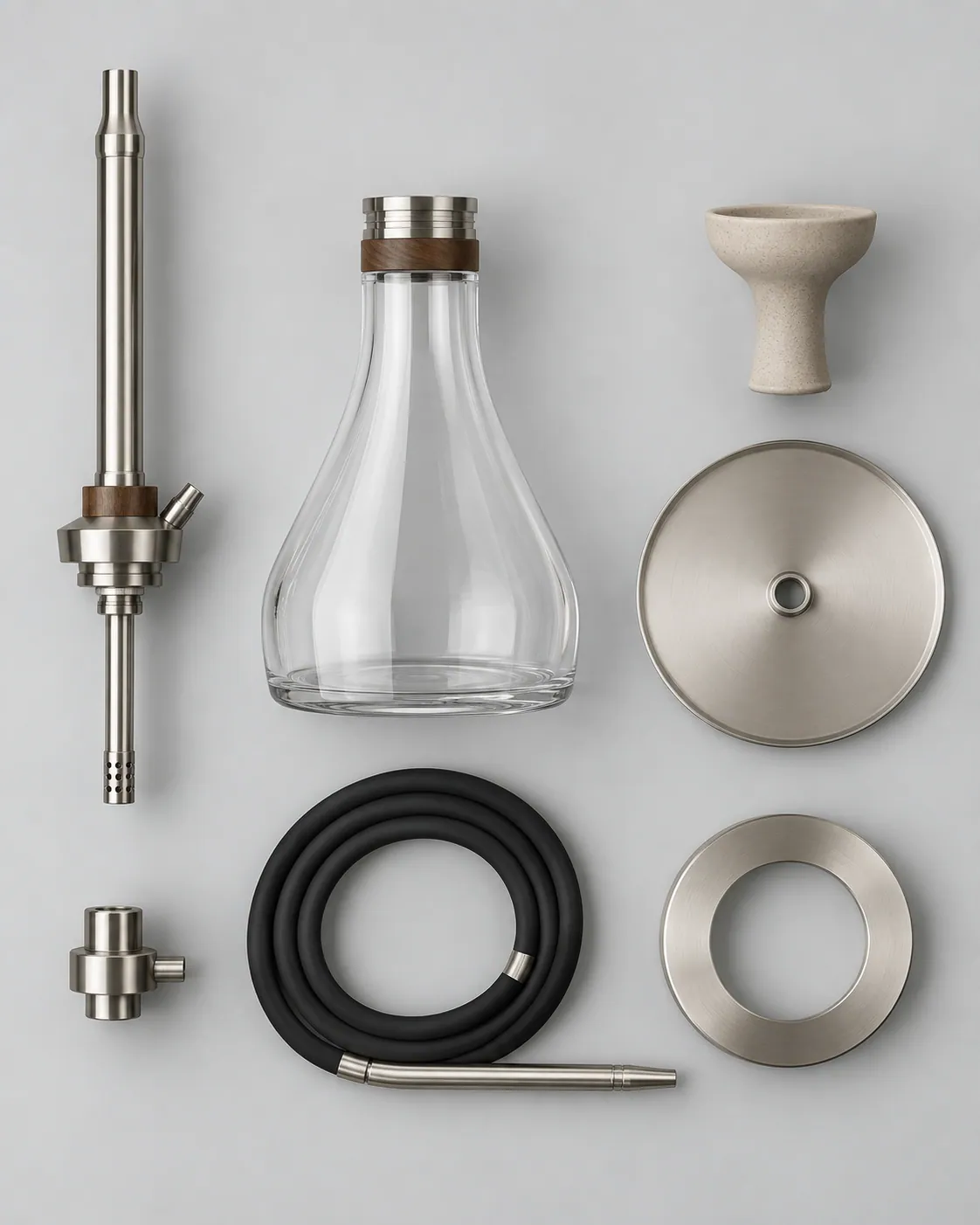
The impact-resistance target decided the bottle material on its own. Five candidates were assessed.
| Material | Impact resistance | Continuous heat | Clarity | Decision |
|---|---|---|---|---|
| Borosilicate glass | Brittle | 400 °C | Excellent | Out — brittle |
| Tritan copolyester | Very high | ~100 °C | Glass-like | Selected |
| Polycarbonate (PC) | Very high | ~115 °C | Good | Out — BPA perception |
| SAN / acrylic | Low | ~80 °C | Good | Out — crazes, scratches |
| 304 stainless | Very high | 800 °C | None | Backup — water not visible |
Continuous-heat figures are approximate ranges for the material family; they will be confirmed against the final supplier's technical data sheet.
The only sensible option that combines the clarity of glass with impact resistance. BPA-free, withstands 70 °C dishwasher cycles, arrives with food-contact certification. Its one known risk is flavour retention: series production will not begin before a blind odour panel is run after fifty wash cycles.
| Part | Conventional solution | NARION solution | Gain |
|---|---|---|---|
| Bowl — café / home | Clay, phosphate ceramic | Cordierite technical ceramic, 5 mm wall | High thermal-shock resistance, does not crack when dropped |
| Bowl — travel | Clay | LSR silicone, high-temperature grade | Flexible; deforms instead of breaking on impact |
| Hose | Leather, fabric wrap | Platinum-cured silicone, Ø12 mm bore | Washable, holds no odour |
| Hose tip | Plaster, resin | CNC aluminium body + silicone mouthpiece | Survives a drop, mouthpiece is replaceable |
| Sealing | Rubber grommet | FKM O-ring, 70 Shore A, Ø2.5 mm section | Does not age, food-contact grade, cheap to replace |
This protocol has not been run yet — it will be executed alongside the pilot series (T2). When results exist they will be published on this page with the measured values.
| Test | Condition | Acceptance criterion | Samples |
|---|---|---|---|
| Drop — travel | 1.5 m, concrete, 3 axes, 10 repetitions | No breakage or leak; cosmetic marks accepted | 5 |
| Drop — café / home | 1.0 m, concrete, bottle full | No breakage, bayonet lock still works | 5 |
| Tip-over | 15° incline, full, hose hanging | Does not tip over on its own | 3 |
| Bayonet life | 2000 full fit–remove cycles | No increase in lock play, no leak | 3 |
| Dishwasher | 200 cycles, 70 °C, commercial detergent | No crazing or yellowing in Tritan, PVD intact | 3 |
| Flavour retention | Blind odour panel after 50 cycles | Previous flavour not detectable | 3 |
| Leak tightness | Pressure-hold test, 60 s | No measurable pressure drop | 100% |
| Thermal — bowl | Continuous load at charcoal temperature, 20 cycles | No cracking, dimensional change negligible | 5 |
| Heavy-metal migration | Food simulant, accredited laboratory | Below the food-contact limits of the target market | Per batch |
No paint and no chrome. In Gulf summer heat paint blisters and chrome peels. PVD (TiN / ZrN) does not scratch and does not fade under UV. This is a durability decision rather than an aesthetic one — coating thickness will be measured on every batch.
Nine finishes distributed across three models. A single product carries at most three at once: metal, coating, warm material. A fourth breaks the upper-segment feel.